
Soy Protein vs Animal Protein: Differential Effects on Muscle Signaling and Androgen Response

Updated: Mar 27
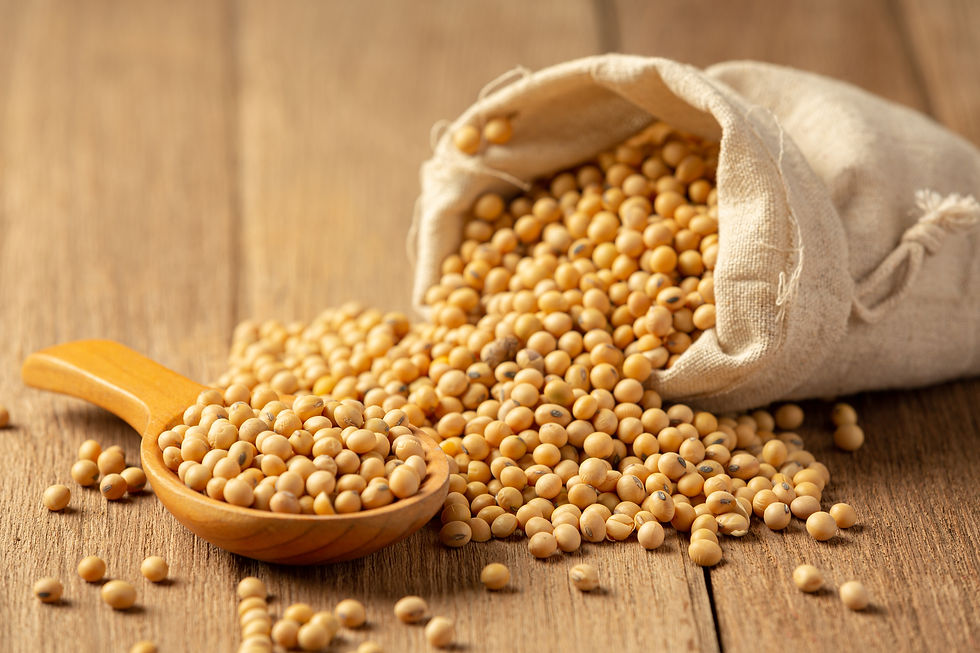
There's a conversation that keeps circulating in fitness and nutrition circles; one that usually goes something like "soy lowers testosterone, so avoid it." And while that claim isn't entirely without basis, it dramatically oversimplifies what's actually happening at the cellular level when you consume different protein sources. If we want to understand why animal and soy proteins produce different anabolic outcomes, we need to move well past the hormone headlines and get into the actual signaling machinery that drives muscle protein synthesis.
The Hormone Argument - And Why It's Incomplete
Yes, soy contains isoflavones, genistein and daidzein being the primary players, which are phytoestrogens that can weakly bind to estrogen receptors. And yes, some research has noted modest reductions in free testosterone or slight increases in estrogen-related markers in men consuming large amounts of soy protein consistently. But here's the thing: the effect sizes in most well-controlled human studies are generally small, and many don't reach clinical significance. The picture gets further muddied when you account for individual variation in gut microbiome composition, specifically whether someone harbors Equol-producing bacteria, which convert daidzein into a more potent estrogen-mimicking compound. Some people are equol producers, others aren't, and that alone creates wildly different hormonal responses to the same dose of soy.
So even before we interrogate the signaling side of things, the "soy tanks your testosterone" narrative is more nuanced than the meme suggests. But that's almost beside the point, because hormones are only part of the anabolic equation.
mTORC1: Where the Real Story Lives
The dominant driver of acute muscle protein synthesis isn't circulating testosterone, it's the mechanistic target of rapamycin complex 1, or mTORC1. This is the master regulator that integrates nutrient availability, mechanical loading, and growth factor signaling to ultimately phosphorylate downstream targets like S6K1 and 4E-BP1, which ramp up translation of contractile proteins. Testosterone matters for long-term anabolic drive and satellite cell activation, but the meal-to-meal signal that tells your ribosomes to start building? That runs through mTOR.
And this is where soy and animal proteins begin to diverge in a really interesting way.
Leucine Kinetics and the Anabolic Trigger
The amino acid leucine is the primary dietary trigger for mTORC1 activation. It doesn't just serve as a building block, it functions as a direct signaling molecule, activating Sestrin2 interactions with the GATOR2 complex and facilitating Rag GTPase-dependent mTORC1 translocation to the lysosomal membrane, where it becomes active. The threshold matters too: there appears to be a leucine "trigger point", roughly around 2–3g of leucine per meal, below which mTORC1 activation is blunted regardless of total protein intake.
Here's where soy takes a hit. Soy protein isolate contains around 7–8% leucine by weight, while whey protein sits closer to 10–11%, and other animal proteins like eggs and beef are in a similar range. That gap might seem small, but at a practical 30–40g protein dose, it can mean the difference between clearing that leucine threshold robustly versus barely grazing it. Studies using stable isotope tracers have consistently shown that whey protein produces a faster, higher peak in blood leucine, and a correspondingly greater acute spike in muscle protein synthesis, compared to soy protein at the same total dose. The rise is more blunted and slower with soy, which translates directly to a reduced mTORC1 response.
Digestibility and Amino Acid Bioavailability
Layered on top of leucine content is the question of how quickly and completely the protein is digested and absorbed. Animal proteins, especially whey, are rapidly digested, releasing amino acids into circulation quickly and producing that sharp postprandial spike that drives mTOR hard. Soy sits in an intermediate zone: it's a complete protein (containing all essential amino acids), and its DIAAS score, the current gold standard for protein quality assessment, is respectable, though it consistently falls short of most animal proteins. Part of this is digestibility, and part of it is a relative shortfall in methionine and lysine compared to animal sources, both of which matter for muscle protein synthesis beyond just leucine alone.
Methionine deserves a specific mention here. It's not just an essential amino acid, it's the universal methyl donor through its conversion to S-adenosylmethionine (SAM), and it feeds into the transsulfuration pathway for glutathione synthesis. Chronically low methionine availability can have downstream effects on cellular redox status and IGF-1 signaling, both of which modulate anabolic capacity over longer timeframes. Animal proteins are generally methionine-rich; soy is comparatively leaner.
Androgen Receptor Sensitivity: A Subtler Layer
Now, here's a piece that rarely gets discussed, the relationship between protein source, amino acid availability, and androgen receptor (AR) sensitivity. Even if circulating testosterone were identical between two conditions, the sensitivity of muscle tissue to androgens matters enormously. There's emerging evidence that leucine and insulin-like growth factor 1 (IGF-1) signaling can upregulate androgen receptor expression and translocation in muscle cells. So a protein source that drives a stronger acute anabolic signal through mTORC1 and IGF-1 may also be indirectly enhancing androgen receptor sensitivity, meaning the same level of circulating testosterone becomes more effective.
Soy's isoflavones add another wrinkle here. Genistein has been shown in vitro to inhibit certain tyrosine kinases and modulate IGF-1 receptor signaling, pathways that intersect with AR function. Whether these effects are meaningful at physiological doses in humans is still an open question, but it suggests the potential for soy to interfere with anabolic signaling through mechanisms that are entirely separate from classic estrogen receptor activity.
The Bigger Picture
None of this is to say soy protein is without value. For vegetarians and vegans, it remains one of the highest-quality plant proteins available, and combining it with complementary sources, or simply consuming more total protein to compensate for the blunted leucine response, can close much of the gap. Research comparing long-term training outcomes between soy and whey supplementation tends to show smaller differences than the acute signaling data might suggest, likely because total daily protein intake and training stimulus dominate the equation over longer periods.
But the mechanism matters if you care about optimizing. The case against soy isn't really about testosterone suppression, it's about a slightly less efficient anabolic signal per gram, driven by lower leucine density, slower amino acid kinetics, and potentially some interference with IGF-1 and androgen receptor pathways through its bioactive phytochemical content. These are subtler forces than a blunt hormonal argument, but they're arguably more relevant to what actually happens inside a muscle cell after you eat.
The next time someone tells you soy is problematic because of estrogen, you can tell them the more interesting story is happening a few steps downstream, at the lysosomal membrane, in the leucine-sensing complexes, and in the fine-tuned receptor sensitivity that separates a strong anabolic environment from a mediocre one.


Comments